


You Bought the Tools. Nobody Knows How to Use Them.
Most businesses aren't losing their AI ROI to bad technology. They're losing it to a gap nobody wants to admit: the distance between "we have AI" and "AI is actually working for us."
Here’s a scenario that’s playing out in businesses everywhere right now.
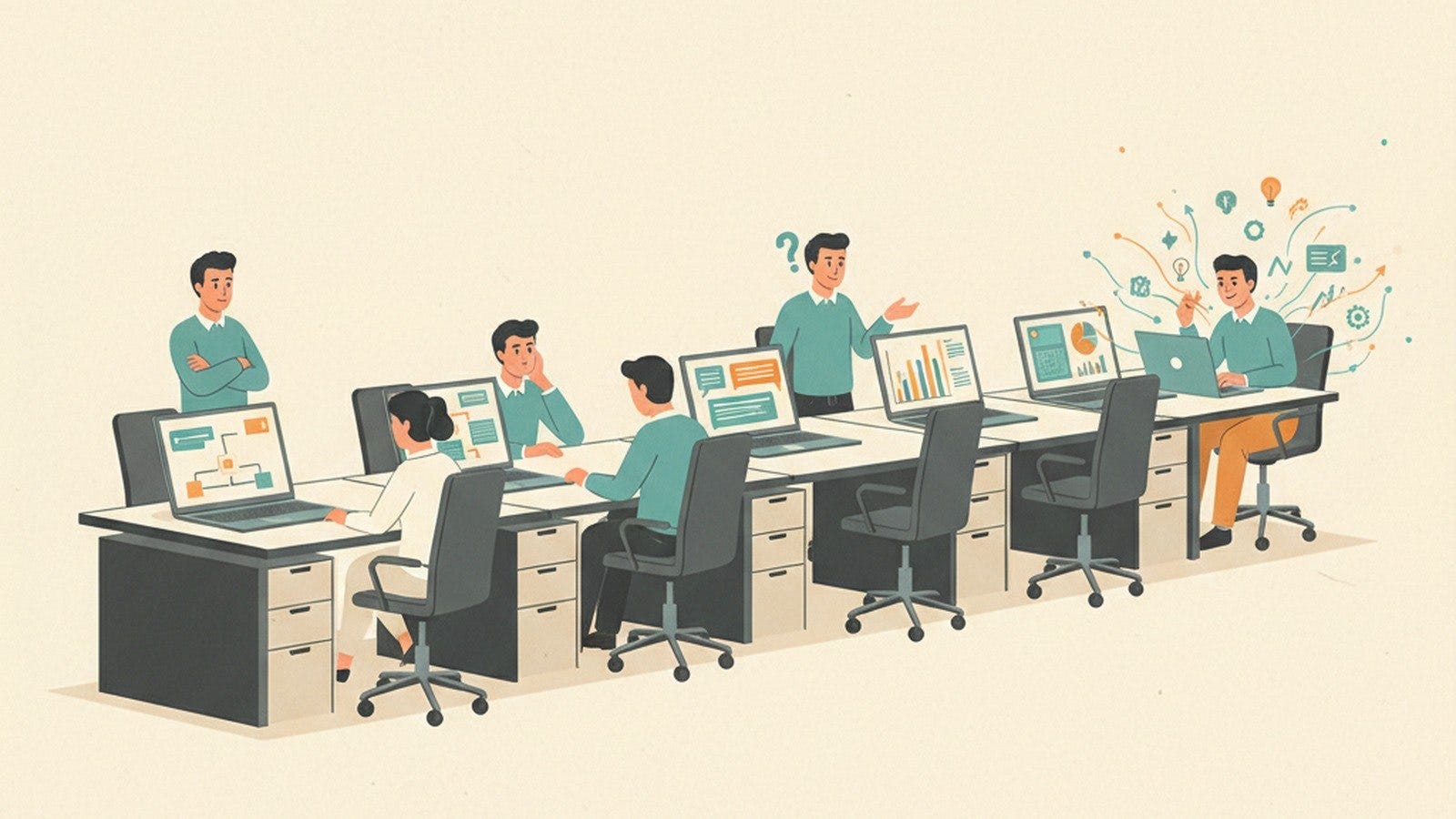
A CEO reads a few articles about AI productivity. Hears from a competitor that they’ve saved 30% on admin work. Gets into a board meeting where someone asks “what’s our AI strategy?” She buys Copilot licenses for the whole team. Maybe adds a couple of other tools - an AI writing assistant, an AI meeting summarizer. Sends out an email: “We’re leaning in on AI.”
Three months later, half the licenses are untouched. The people using the tools are using them exactly the way they used Google - type in a question, get back an answer, move on. And the CEO is wondering why the productivity numbers haven’t moved.
This is the AI adoption gap. And right now it is the most expensive problem in small and mid-size business.
The Numbers Are Uncomfortable
Here’s what this week’s research says about where businesses actually stand.
According to a recent IBM CEO study, 85% of employees are technically capable of using AI - they have access, they have the logins - but only 25% actually do. That’s a 60-point gap between potential and reality. IBM calls it the “AI adoption gap.” I’d call it money left on the table every single day.
A Docebo study published this year surveyed 2,000 enterprise professionals across six countries and found that 85% of employees say the AI training they received doesn’t help them use AI in their specific roles. Not a small number. Not a fringe complaint. The vast majority of workers who went through their company’s AI training program came out the other side unable to apply it.
And then there’s this: Goldman Sachs found that employees at companies with ChatGPT enterprise accounts save an average of 40 to 60 minutes per day - when they actually use the tool correctly. That’s real time. Real capacity. Real money. Most teams aren’t getting anywhere near it.
The tools work. The deployment is broken.
Why the Gap Exists
The way most businesses approach AI adoption goes like this: buy tool, add to stack, send login, declare success. What almost never happens is the step in between - actually mapping the tool to a specific workflow, showing people what “good” looks like, and building a habit around it.
Training programs exist, technically. World Economic Forum data shows 77% of employers plan to retrain their workforce for AI. But only 13% of employees have received any meaningful AI training. The gap between intent and execution is enormous.
And even when training does happen, it tends to be generic. “Here’s what ChatGPT can do.” “Here’s how to write a prompt.” It’s the equivalent of teaching someone to type without telling them what they’re supposed to write. Employees leave the training session, return to their actual jobs, and can’t figure out how to connect what they learned to the specific tasks in front of them.
There’s also a shadow AI problem running in the opposite direction. A 2026 study of 6,000 knowledge workers found that 50% are using unapproved AI tools - tools they found on their own, without IT review or any formal process. These are the employees who figured it out, who are actually getting value. But they’re doing it in a way that creates security exposure and zero institutional knowledge. When they leave, the capability walks out with them.
So you have two failure modes running simultaneously: half your team not using AI at all, and the other half using it in ways the company can’t see or control.
This Is a Management Problem
The instinct, when productivity numbers are flat, is to buy a better tool. Upgrade to the enterprise tier. Add another platform. Find the thing that’s “easier to use.” That instinct is wrong.
The BCG AI Radar 2026, which surveyed 2,360 executives, found that only 5% of enterprises are achieving substantial ROI from AI at scale. Not 50%. Not 30%. Five percent. And the pattern across the companies that are getting returns is consistent - they didn’t find better technology. They built better systems around the technology they already had.
The difference between the 5% and the 95% isn’t the tools. It’s the workflow design, the role-specific training, and the management accountability for actual adoption.
For an SMB, that means three things.
First, you need to pick a lane. Not “we use AI everywhere” - that’s a recipe for the scenario above. Pick one workflow, one team, one measurable outcome. Document what good looks like. Build the habit there before expanding.
Second, the training needs to be job-specific. Not “here’s what Claude can do” - your account manager doesn’t care. The question is: what does Claude do for this specific part of your account manager’s job? What’s the prompt? What does a good output look like? What do they do with it next? Generic AI training produces generic, non-existent results.
Third, someone has to own it. AI adoption doesn’t happen because tools are available. It happens when a manager is checking in on it, asking how it went, removing blockers, and celebrating wins. If nobody’s accountable for adoption, nobody adopts.
What This Actually Costs
Goldman Sachs’ data points to 40 to 60 minutes of time savings per person per day - when AI is being used well. For a team of 10 people, that’s 400 to 600 minutes of capacity recovered every single day. Over a year, at even a modest hourly rate, that’s six figures of productivity sitting idle because nobody built a proper adoption process.
Most businesses looking at flat AI ROI don’t need to go shopping for new tools. They need to go back and do the work they skipped the first time - the workflow design, the role-specific playbook, the accountability structure.
The technology is ready. The question is whether the organization is.
If this gap sounds familiar - licenses paid for, tools mostly ignored, unclear whether any of it is actually working - that’s exactly what Black&Tan Labs’ Discovery engagement is designed to address. It’s a structured, full-day process where we map your existing AI stack to your actual workflows, identify where the adoption gap is costing you the most, and build a concrete plan to close it. Not more tools. A system that actually gets used.
Learn more at blackandtanlabs.com
Enjoyed this? New essays on AI, operations, and building in contrast - delivered to your inbox.
Subscribe on Substack →